Managing is not the same as administering. Managing is linked to having to make decisions based on information which may or may not be available or complete. Administering, on the other hand, is ensuring all steps and actions are in line with clearly stated guidelines. There is less scope for discretionary decision that is in-built in managing.
In view of this, managing sometimes call for gut-feel decision based on the risk-reward axis. Accountability is the hall-mark of managing. In administering, the rules need to be adhered to, notwithstanding the situation. Any departure from the stated rules is looked upon as non-compliance.
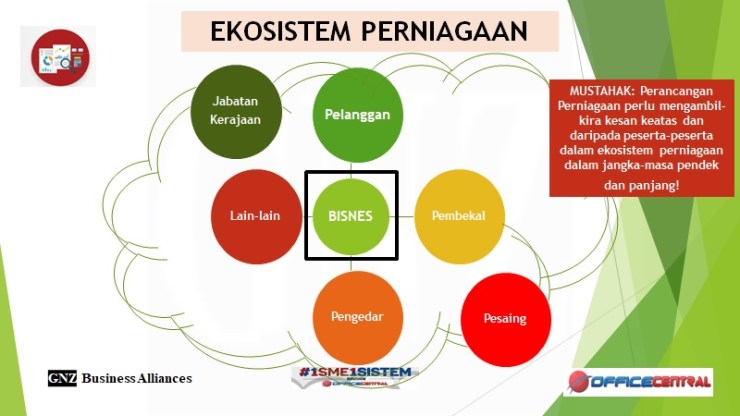
As entrepreneurs, it is important to realise that business is managed and not administered! This means, any decision that the entrepreneur makes in relation to the business would normally be based on non-complete and hazy information as time is of essence. Hence business management to steer the business to a safe and secure future well-being is a challenge indeed for entrepreneurs. This is more so since the business does not exist in isolation but exists within a business ecosystem. It is impacted by actions by other players in the ecosystem and impacts others in the ecosystem. A business ecosystem can be diagrammatically shown as below:
Fortunately, there are tools available to help entrepreneurs in managing their business. These tools allow entrepreneurs when making business decisions to be on the risk-reward axis where relevant information which can be extracted from such business tools are available.
These tools can be categorised as “Enterprise Management System” (EMS). At its very basic level, EMS would be on a single functionality mode. For instance, function related to accounting, or marketing, or HRMS. The focus is narrow and specialised. Invariably, accounting would be among the first function that a business seeks under EMS.
However, an EMS need to have a wider scope in terms of functionality. This is because EMS needs to address the three segments existing in every business.
The three segments are front-end segment, middle segment, and back-end segment. Awareness and understanding this segmental concept is key for entrepreneurs. The segments, however, may not always be as clear-cut or pre-defined. Some of them may be merged together or some may be split further.
The front-end segment primary deals with activities related to customer and marketing. The middle segment relates mainly to raw materials and production process; whilst the back-end segment relates to activities that “glue” the different parts of the business together in terms of financial planning and reporting, and compliance to regulations and laws within the business ecosystem.
The three segments can be diagrammatically shown as below:

An Enterprise Management System (EMS), hence, should be able to fulfill most of the primary functions within a business as dictated by the three major segments as explained above. A business using only a single function such as accounting would only be addressing certain requirements at the back-end segment. The more the functions are available and integrated, and used as a business tool, the larger would be the information base, from which relevant information can be extracted and analysed, in support of the decision-making process by the entrepreneur.
In this context, entrepreneurs managing businesses can hopefully make better decisions for the future well-being of the business. This is due to “blind-spots” appearing before the entrepreneur can be reduced and “visibility” in the business horizon be clearer and enhanced.
A final note on the segments within a business. People within the business must collaborate and act as a team where internal disputes or interests need to be subservient to the needs of the customer or external party. Even though people in the business inevitably see themselves as belonging to different sections, it is vital to realise that the customer on the outside sees staff as one and the same organisation.
Any bad experience with any one person would paint a bad image of the business, even though accountability is with another person! Thus, staff must be fully conversant on the meaning and implications of “Customer Relationship Management (CRM).”
I shall continue further on this topic in my future write-up. Watch this space.
GNZ.
 Institut Memandu Jaafar Othman